

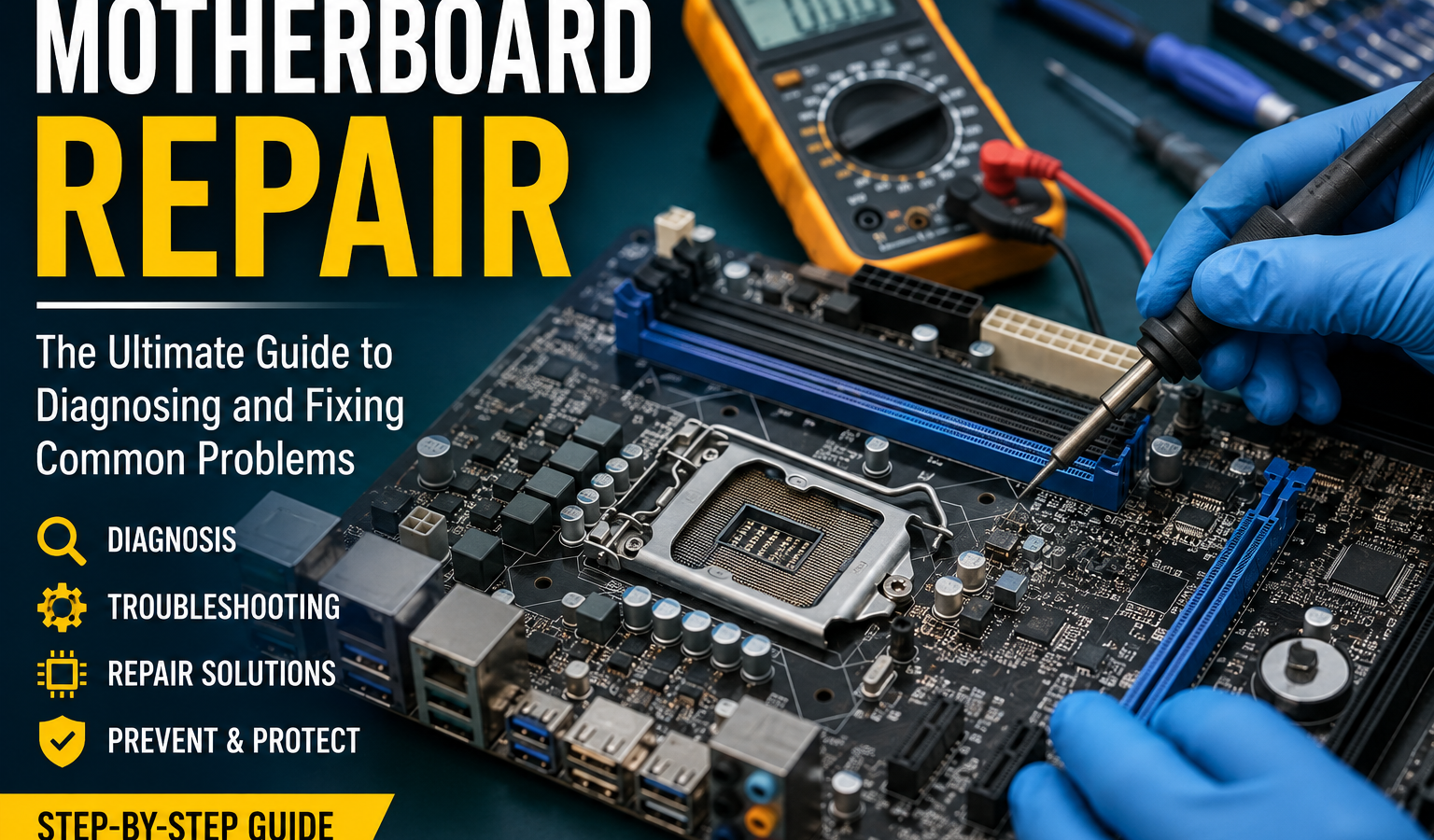
Your computer can have a powerful processor, plenty of RAM, and a fast SSD, but none of those components can work properly if the motherboard has a serious problem.
The motherboard is the main circuit board that connects almost every important component in a computer. When something goes wrong with it, you might experience symptoms ranging from random shutdowns and USB failures to a completely dead PC.
The good news is that motherboard repair does not always mean replacing the entire board. Some problems are caused by loose cables, incorrect BIOS settings, a bad CMOS battery, faulty RAM, or a damaged connector. Other faults, such as failed MOSFETs, shorted capacitors, or damaged motherboard traces, require electronics-level repair.
This guide explains how to repair a motherboard, how to diagnose common faults, which repairs are suitable for beginners, and when you should take a damaged motherboard to a professional.
What Is Motherboard Repair?
Motherboard repair is the process of diagnosing and correcting faults on a computer’s main circuit board.
A repair can range from a simple troubleshooting step to advanced board-level electronics work.
For example, a basic repair might involve:
- Reseating RAM
- Reconnecting motherboard power cables
- Replacing a CMOS battery
- Clearing CMOS
- Updating or recovering BIOS/UEFI
- Removing a faulty expansion card
- Checking for damaged USB ports
More advanced PC motherboard repair may involve:
- Testing voltage rails
- Finding short circuits
- Replacing MOSFETs
- Replacing capacitors
- Repairing damaged traces
- Replacing connectors
- Microsoldering small components
- Diagnosing VRM or power-management faults
The important distinction is that troubleshooting and board-level repair are not the same thing. You can safely troubleshoot many motherboard problems at home, but component-level repair requires specialized tools and experience.
Common Signs of a Damaged Motherboard
A motherboard can fail in several different ways. Sometimes the symptoms are obvious; other times they look like a CPU, RAM, power supply, or storage problem.
Common signs include:
- The computer does not turn on.
- The PC turns on but produces no display.
- Fans spin but the system does not boot.
- USB ports stop working.
- RAM is not detected.
- PCIe devices are not recognized.
- The computer randomly shuts down.
- The system repeatedly restarts.
- BIOS/UEFI cannot be accessed.
- Burning smells or visible component damage appear.
- The motherboard shows diagnostic LEDs or error codes.
- Certain onboard features stop working.
Does a Dead PC Always Mean a Bad Motherboard?
No.
A motherboard not working symptom does not automatically mean the motherboard is defective.
A dead PC can also be caused by:
- A failed power supply
- Loose power cables
- Faulty RAM
- A defective CPU
- A short circuit
- A faulty power button
- A graphics card problem
- A damaged peripheral
- BIOS/UEFI problems
This is why proper motherboard diagnostics are important before buying a replacement.
Common Causes of Motherboard Problems
Understanding what causes motherboard failure can make diagnosis much easier.
1. Power Surges
A sudden voltage surge can damage motherboard power circuits, MOSFETs, VRMs, or other components.
Using a good-quality surge protector and a reliable power supply can reduce the risk.
2. Overheating
Excessive heat can affect electronic components over time. Poor airflow, blocked cooling systems, or high operating temperatures can contribute to hardware failure.
3. Liquid Damage
Liquid and electronics are a dangerous combination. Even a small spill can cause corrosion or short circuits.
If liquid reaches the motherboard, turn the system off immediately and disconnect power.
Do not repeatedly turn the computer on to “see if it still works.”
4. Physical Damage
Motherboards can be damaged during installation or transportation.
Examples include:
- Scratched PCB traces
- Bent CPU socket pins
- Cracked circuit boards
- Damaged connectors
- Broken PCIe slots
5. Static Electricity
Electrostatic discharge can damage sensitive electronic components.
Always ground yourself properly before handling a motherboard, especially when installing or removing components.
6. Faulty Components
A defective PSU, CPU, RAM module, or expansion card can sometimes cause symptoms that appear to be a motherboard problem.
7. Aging Components
Older boards can eventually develop problems with components such as capacitors, connectors, and power circuits.
How to Diagnose a Motherboard Problem
Before attempting motherboard repair, determine whether the motherboard is actually responsible.
A systematic diagnosis is much better than randomly replacing parts.
Step 1: Disconnect Power
Shut down the computer and disconnect the AC power.
For a desktop, switch off the PSU if it has a power switch and unplug it.
For a laptop, disconnect the charger and, where practical and appropriate for the model, disconnect the internal battery before working inside.
Safety warning: Never work on a powered motherboard unless you have the proper electronics training and equipment.
Step 2: Inspect the Motherboard
Look carefully for:
- Burn marks
- Cracked PCB areas
- Swollen or leaking capacitors
- Corrosion
- Broken connectors
- Bent socket pins
- Damaged USB ports
- Loose components
A visual inspection can sometimes reveal the cause immediately.
Step 3: Check the Power Connections
A desktop motherboard commonly receives power through the main motherboard power connector and a separate CPU power connector.
Make sure both are firmly connected.
A loose CPU power connector can produce a system that appears completely dead or fails to start correctly.
Step 4: Test the RAM
Remove the RAM and reinstall it carefully.
If you have multiple memory modules, test them individually using the motherboard’s recommended memory slot configuration.
RAM problems can produce symptoms that look like motherboard failure.
[Internal Link: How to Check RAM Health]
Step 5: Clear CMOS
Clearing CMOS can reset certain BIOS/UEFI settings to their defaults.
This can help if the system stopped booting after a configuration change, overclocking attempt, or incorrect firmware setting.
Some motherboards have a clear-CMOS jumper or button. Follow the motherboard manufacturer’s instructions for your exact model.
Step 6: Check Diagnostic Indicators
Modern motherboards may have:
- Debug LEDs
- POST codes
- Speaker beep codes
- Diagnostic displays
These indicators can help identify whether the problem is associated with CPU, RAM, graphics, or boot devices.
Step 7: Test With Minimal Hardware
For a desktop PC, remove unnecessary hardware and attempt to start the system with only essential components.
This helps isolate whether an expansion card, USB device, storage drive, or other component is causing the problem.
Step-by-Step Motherboard Repair Troubleshooting
Once you’ve confirmed that the problem is related to the motherboard or its connections, work through these steps.
1. Check the PSU First
A faulty power supply can mimic motherboard failure.
If the PSU is suspected, use a known-good compatible PSU or appropriate testing equipment rather than assuming the motherboard is defective.
2. Check for Shorts
Make sure the motherboard is installed correctly in the computer case.
An incorrectly positioned motherboard standoff can potentially create a short against the PCB.
3. Inspect the CPU Socket
On many desktop platforms, bent socket pins can prevent proper CPU or memory operation.
Inspect the socket under good lighting.
Do not force the CPU into place.
4. Test RAM Configuration
Try one known-good RAM module at a time.
If the system works with one module but not another, the memory may be the problem rather than the motherboard.
5. Reset BIOS/UEFI Settings
Incorrect firmware settings can prevent a system from completing POST.
Resetting the settings can be an effective troubleshooting step.
6. Test USB and Other Ports
If only specific USB ports have stopped working, the entire motherboard may not be defective.
A damaged connector or localized circuit can cause a port-specific failure.
7. Stop Before Board-Level Repair
If diagnosis points toward a failed component on the PCB, stop if you do not have electronics repair experience.
Replacing a surface-mounted component requires the correct equipment and technique. Incorrect soldering can cause additional damage.
Motherboard Components You Should Understand
Knowing the basic motherboard components makes troubleshooting much easier.
| Component | Main Function |
|---|---|
| CPU socket | Connects the processor to the motherboard |
| RAM slots | Connect system memory |
| CMOS battery | Maintains certain firmware settings and real-time clock information |
| BIOS/UEFI | Firmware responsible for hardware initialization and boot processes |
| VRMs | Convert and regulate power supplied to the CPU and other circuits |
| MOSFETs | Electronic switching components commonly used in power circuits |
| Chipset | Provides platform-level I/O and connectivity functions, depending on platform design |
| PCIe slots | Connect graphics cards and other expansion devices |
| Power connectors | Supply electrical power to motherboard circuits and CPU |
| USB ports | Connect external USB devices |
| Motherboard traces | Conduct electrical signals and power across the PCB |
What Are VRMs?
VRM stands for Voltage Regulator Module.
The VRM converts incoming power into the voltage levels required by the CPU and other components.
A VRM fault can result in:
- Failure to power on
- System instability
- Unexpected shutdowns
- CPU-related errors
Board-level VRM diagnosis should generally be left to a qualified technician.
What Are MOSFETs?
MOSFETs are semiconductor switching devices widely used in motherboard power circuits.
A failed MOSFET can sometimes create a short circuit or prevent a particular voltage rail from operating correctly.
Testing and replacing these components requires appropriate electronics equipment.
What Are Motherboard Traces?
Traces are conductive pathways built into the PCB.
Think of them as extremely small electrical roads connecting different parts of the motherboard.
A scratched or broken trace can interrupt a signal or power connection. Repairing traces is possible in some situations, but it requires precision and appropriate tools.
Common Motherboard Problems and Their Solutions
PC Turns On but There Is No Display
Possible causes include:
- RAM problems
- GPU problems
- CPU installation issues
- BIOS/UEFI configuration
- Power connections
- Motherboard failure
Start with basic POST troubleshooting before assuming the board is damaged.
Computer Randomly Restarts
Potential causes include:
- PSU problems
- CPU overheating
- RAM instability
- VRM problems
- BIOS settings
- Driver or operating-system issues
Check temperatures and system stability before attempting board-level repair.
USB Ports Are Not Working
If one USB port fails, the connector or localized circuit may be damaged.
If all USB ports fail, investigate BIOS settings, chipset-related functions, power delivery, and operating-system issues.
Motherboard Does Not Detect RAM
First check:
- Whether the RAM is compatible.
- Whether the module is correctly installed.
- Whether another memory slot works.
- Whether the BIOS is configured correctly.
- Whether the RAM module itself is faulty.
If known-good RAM consistently fails across appropriate slots, motherboard or CPU-related issues become more likely.
Motherboard Has No Power
Check:
- PSU
- Main motherboard power connector
- CPU power connector
- Case power switch
- Short circuits
- Standby power
- Motherboard power circuitry
If appropriate power is reaching the board but its power-management circuits do not respond correctly, professional diagnosis may be necessary.
Can You Repair a Motherboard Yourself?
Yes, some motherboard problems can be repaired at home, but board-level motherboard repair is not suitable for everyone.
Beginner-Friendly Tasks
You can usually attempt basic troubleshooting such as:
- Reseating RAM
- Checking cables
- Replacing the CMOS battery
- Clearing CMOS
- Removing unnecessary peripherals
- Inspecting for obvious physical damage
- Testing components individually
Advanced Repairs
Professional equipment and experience are generally required for:
- MOSFET replacement
- Surface-mount component replacement
- Trace repair
- Connector replacement
- Short-circuit diagnosis
- BIOS chip programming
- VRM repair
- Liquid-damage restoration
If you do not understand electronics, do not experiment with live voltage measurements or soldering on a motherboard.
Tools Needed for Motherboard Repair
The tools depend on the type of repair.
Basic Troubleshooting Tools
- Phillips screwdriver
- Anti-static wrist strap
- Flashlight
- Known-good RAM
- Known-good PSU for desktop testing
- Motherboard manual
- Compressed air or suitable cleaning equipment
Professional Board-Level Tools
A motherboard repair technician may use:
- Digital multimeter
- Bench power supply
- Oscilloscope
- Hot-air rework station
- Soldering station
- Microscope
- BIOS programmer
- Thermal imaging equipment
- Current-limiting equipment
- Board schematics or boardview information when available
Having expensive equipment alone does not make someone qualified to perform motherboard repair. Experience with electronics diagnosis is equally important.
Laptop vs. Desktop Motherboard Repair
Desktop motherboard repair is often more accessible because components such as RAM, CPU, storage, and graphics cards are usually easier to remove and test.
Laptop motherboard repair can be significantly more complex.
| Feature | Desktop | Laptop |
| Component access | Usually easier | Often difficult |
| RAM | Often replaceable | May be replaceable or soldered |
| CPU | Often socketed | Frequently soldered |
| GPU | Often removable | Frequently integrated/soldered |
| Board replacement | Usually simpler | Can be more involved |
| Board-level repair | Possible | Often requires specialized skills |
Laptop motherboard repair commonly involves small surface-mounted components and tightly packed circuits. A microscope, hot-air station, schematics, and specialized diagnostic knowledge may be required.
Motherboard Repair Cost: What Should You Expect?
The motherboard repair cost depends heavily on the fault, motherboard model, replacement parts, labor, and whether the repair is component-level or requires board replacement.
A simple repair, such as replacing a battery or connector, can be relatively inexpensive.
A complicated repair involving power circuits, damaged traces, or liquid corrosion can cost considerably more.
Factors affecting the price include:
- Desktop or laptop motherboard
- Motherboard age
- Availability of replacement parts
- Type of failure
- Labor required
- Diagnostic complexity
- Extent of liquid or physical damage
- Availability of replacement motherboard
Because repair pricing varies significantly by location and fault, a technician should diagnose the board before giving you a final estimate.
When Should You Replace Instead of Repairing a Motherboard?
Motherboard repair is not always the most economical option.
Replacement may make more sense when:
- The motherboard is very old.
- Replacement boards are readily available.
- Repair costs approach replacement cost.
- Multiple areas of the board are damaged.
- The PCB is physically cracked.
- Liquid corrosion is widespread.
- Replacement parts are difficult to source.
- The system uses outdated hardware.
For an expensive workstation or specialized laptop, professional repair may still be worthwhile even when a replacement board is difficult or expensive to obtain.
The best decision depends on the board’s value, repair cost, age, and availability of replacement hardware.
How to Prevent Future Motherboard Damage
A few simple habits can significantly reduce avoidable motherboard problems.
Keep the PC Cool
Maintain good airflow and clean dust from the cooling system.
Use a Reliable PSU
A poor-quality or failing power supply can put other components at risk.
Protect Against Power Problems
Use suitable surge protection and consider a UPS where appropriate.
Handle Components Carefully
Avoid touching circuit contacts unnecessarily and use anti-static precautions.
Keep Liquids Away
Never place drinks near an open desktop or laptop.
Install Hardware Correctly
Do not force RAM, CPUs, expansion cards, or connectors into their slots.
Update Firmware Carefully
BIOS/UEFI updates can be useful, but use the correct firmware for your exact motherboard model and follow the manufacturer’s instructions.
When Should You Contact a Motherboard Repair Technician?
You should consider professional help when:
- The motherboard has burn damage.
- You see corrosion from liquid exposure.
- The system has a suspected short circuit.
- A VRM or MOSFET appears damaged.
- The motherboard needs microsoldering.
- BIOS firmware requires specialized recovery.
- A connector needs board-level replacement.
- You lack the tools to diagnose the fault safely.
A qualified motherboard repair technician can use electrical measurements and board-level diagnostic methods to identify faults that cannot be found through normal PC troubleshooting.
Frequently Asked Questions About Motherboard Repair
What is motherboard repair?
Motherboard repair is the process of diagnosing and fixing faults on a computer’s main circuit board. It can include simple component replacement, connector repair, BIOS recovery, trace repair, or advanced electronics work.
Can a completely dead motherboard be repaired?
Sometimes. A dead motherboard may have a repairable power circuit, damaged connector, BIOS issue, or another localized fault. However, a severely damaged PCB may not be economically repairable.
How do I know if my motherboard is bad?
Look for symptoms such as no power, failed POST, unexplained shutdowns, missing RAM or PCIe devices, damaged components, or persistent failures after other hardware has been tested.
A proper motherboard diagnostic is needed before confirming the board is defective.
What are the most common motherboard problems?
Common problems include power-related faults, failed ports, BIOS/UEFI issues, damaged connectors, RAM detection problems, overheating-related failures, liquid damage, and physical PCB damage.
Can a motherboard be repaired without replacing it?
Yes. Some motherboards can be repaired by replacing individual components, connectors, or damaged traces. Whether repair is practical depends on the specific fault and board design.
How much does motherboard repair usually cost?
There is no universal price. The cost depends on the motherboard, type of failure, parts, labor, and local repair rates. A technician should diagnose the fault before providing an accurate quote.
Is motherboard repair worth it?
It can be, especially when the motherboard is expensive, difficult to replace, or contains specialized hardware. For an older, inexpensive board, replacement may be more economical.
Can I repair a motherboard myself?
You can safely perform many basic troubleshooting steps yourself. Advanced repairs involving soldering, MOSFETs, VRMs, traces, or board-level shorts should generally be handled by someone with electronics repair experience.
How long does motherboard repair take?
Simple repairs may be completed quickly, while complex board-level diagnosis can take much longer. Availability of replacement components and the complexity of the fault also affect turnaround time.
Final Verdict: Is Motherboard Repair Worth It?
Motherboard repair can be worthwhile, but the right approach depends on the type of failure.
If your computer will not start, do not immediately assume that the motherboard is dead. Check the PSU, cables, RAM, CPU installation, BIOS/UEFI settings, and other hardware first. Many apparent motherboard problems are actually caused by another component.
Basic motherboard troubleshooting is accessible to many PC users. However, once the diagnosis points toward failed MOSFETs, VRMs, damaged traces, short circuits, or other board-level faults, professional help is usually the safer choice.
The most important rule is simple: diagnose before replacing. A careful diagnosis can save you money, prevent unnecessary parts purchases, and determine whether repairing or replacing the motherboard makes the most sense.
For a valuable desktop, gaming PC, workstation, or laptop, a skilled motherboard repair technician may be able to restore a board that would otherwise be unnecessarily discarded.




[…] beginners, the most important thing to remember is that the motherboard is the foundation of a PC build. It does not replace the CPU, GPU, or RAM, but it provides the […]
[…] motherboard repair guide […]