

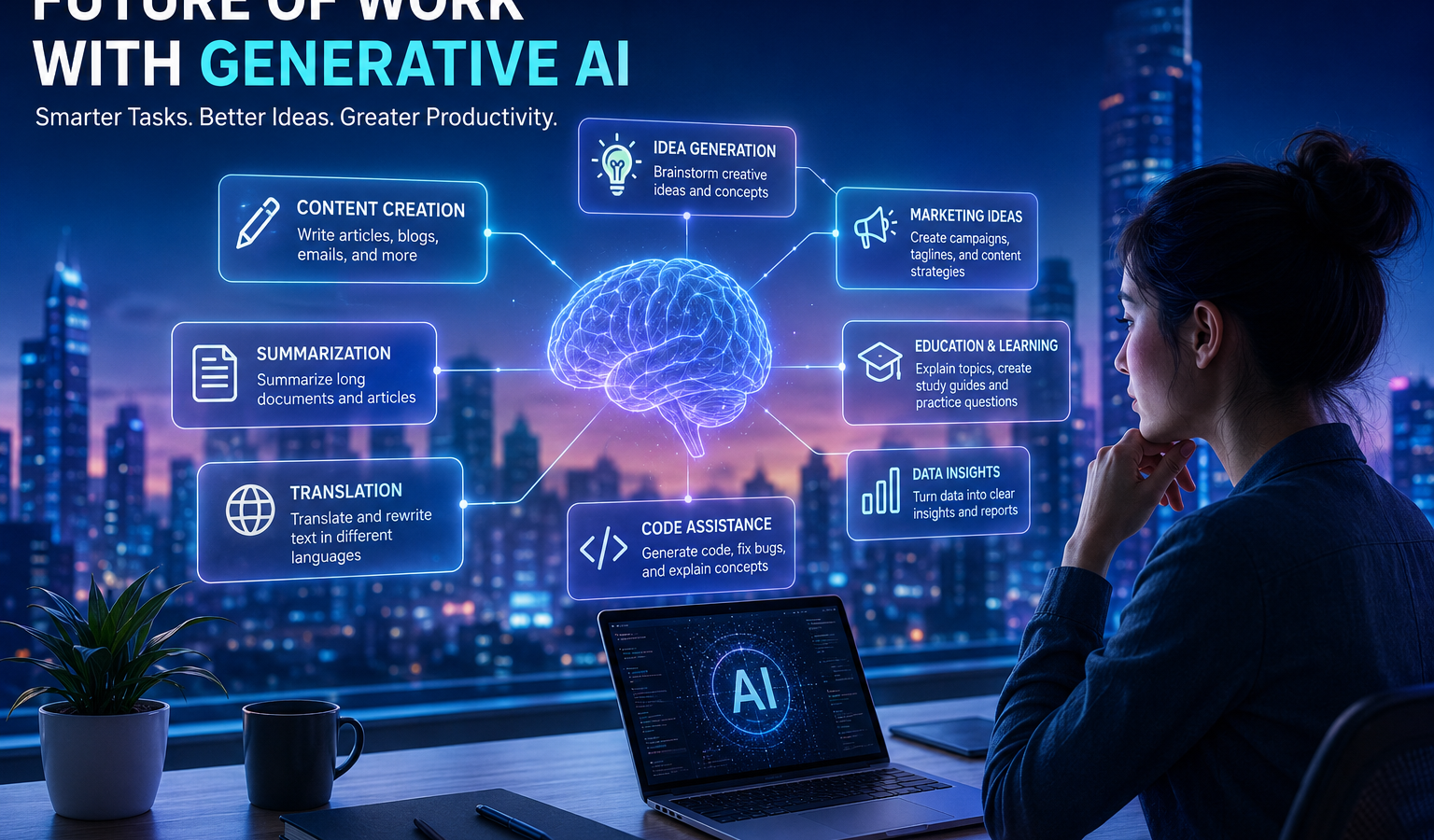
What would be an appropriate task for using generative AI? A good example is brainstorming ideas, drafting an email, summarizing information, creating an outline, rewriting text, or generating a first draft of content. Generative AI works best when the task involves language, creativity, patterns, or repetitive work and a person can review the final result for accuracy and quality.
What Is Generative AI?
Generative AI is a type of artificial intelligence designed to create new content based on patterns learned from existing data. Depending on the tool, it can generate text, images, audio, video, computer code, summaries, ideas, and other forms of content.
For example, a generative AI tool can turn a short instruction into a blog outline, explain a difficult concept in simpler language, create email drafts, or suggest ideas for a marketing campaign.
The important point is that generative AI is generally most useful as an assistant, rather than an unquestionable source of truth.
A person can provide the goal and context, let the AI produce a starting point, and then review, correct, and improve the result.
What Would Be an Appropriate Task for Using Generative AI?
An appropriate task for generative AI is one where the system can save time by producing, transforming, organizing, or expanding information while a human remains able to review the output.
Good examples include:
- Brainstorming ideas
- Creating content outlines
- Drafting emails
- Summarizing documents
- Rewriting text
- Generating marketing concepts
- Explaining educational topics
- Translating or changing the tone of text
- Creating creative concepts
- Assisting with software development
For instance, instead of spending 30 minutes thinking of possible blog topics, a writer could ask an AI tool to generate 20 ideas. The writer can then select the strongest ideas, check them against the audience’s needs, and develop the final content.
This makes generative AI particularly useful for first drafts and idea generation, where human review can improve the final result.
Best Tasks for Using Generative AI
1. Brainstorming Ideas
AI for brainstorming is one of the simplest and safest generative AI use cases.
You can ask an AI tool to generate:
- Blog topics
- Business ideas
- Product names
- Social media concepts
- Video ideas
- Questions for interviews
- Creative story concepts
- Advertising angles
For example, a small business owner could ask for 20 content ideas for a local furniture company.
Why AI helps: It can quickly produce many possibilities, giving you a starting point when you have limited ideas.
Human verification: Evaluate the ideas for originality, relevance, audience fit, and practical value.
2. Drafting and Improving Written Content
Generative AI can help create a first draft of an email, article, product description, report, or social media post.
It can also improve existing writing by:
- Correcting grammar
- Simplifying complicated sentences
- Changing tone
- Improving structure
- Making text more concise
- Suggesting alternative wording
For example, a professional could provide rough notes and ask an AI tool to turn them into a clear business email.
Why AI helps: It reduces the time required to turn rough ideas into readable text.
Human verification: Check facts, tone, names, numbers, and whether the final version accurately represents your intended message.
3. Summarizing Information
AI for summarization is another appropriate task, particularly when someone needs to understand a long piece of material quickly.
Generative AI can summarize:
- Meeting notes
- Articles
- Reports
- Research material
- Business documents
- Long emails
- Educational content
For example, a manager could use AI to turn lengthy meeting notes into a short list of decisions and action items.
Why AI helps: It can organize large amounts of text into a more manageable format.
Human verification: When the information is important, compare the summary with the original material. A summary can leave out context or misunderstand an important detail.
4. Creating Outlines
Creating an outline is a task where generative AI can provide useful structure without necessarily replacing human expertise.
A student might ask for an outline for a presentation. A writer could request a structure for a 2,000-word article. A business professional could ask for a proposed structure for a report.
The user can then modify the outline based on their goals.
Why AI helps: It can quickly suggest a logical order for ideas.
Human verification: Make sure the structure supports the actual purpose of the document and does not introduce irrelevant sections.
5. Generating Marketing Ideas
Businesses can use generative AI to explore marketing possibilities.
For example, AI can help create:
- Campaign concepts
- Ad copy variations
- Customer personas
- Product descriptions
- Email subject lines
- Social media ideas
- Content calendars
- Calls to action
A marketing specialist might ask AI to produce five different advertising approaches for the same product, each aimed at a different audience.
Why AI helps: It allows marketers to explore multiple approaches quickly.
Human verification: Check brand guidelines, factual claims, customer expectations, cultural context, and legal requirements.
6. Writing Emails and Business Communications
Routine communication can consume a surprising amount of time.
Generative AI can help draft:
- Customer responses
- Meeting invitations
- Follow-up emails
- Internal announcements
- Professional requests
- Project updates
For example, an employee can provide three bullet points about a project and ask AI to create a professional status update.
The employee should still review the message before sending it.
7. Creating Educational Explanations
Generative AI can explain difficult subjects in simpler language.
A student might ask:
“Explain photosynthesis as if I am 12 years old.”
The same student could then request an analogy, examples, practice questions, or a short quiz.
Teachers can also use AI to brainstorm lesson activities, discussion questions, and different explanations of a topic.
Why AI helps: It can adapt explanations to different levels and formats.
Human verification: Educational content should be checked against reliable sources, particularly when the subject involves technical, scientific, historical, or current information.
8. Translating and Rewriting Text
Generative AI can help translate or transform existing text.
Common tasks include:
- Simplifying technical language
- Rewriting content for a different audience
- Changing formal writing into conversational language
- Translating short passages
- Creating alternative versions of a message
However, important legal, medical, financial, or official translations may require a qualified human translator.
9. Generating Creative Concepts
Generative AI is also suitable for creative exploration.
It can help develop:
- Story ideas
- Character concepts
- Video concepts
- Design directions
- Image prompts
- Names
- Slogans
- Creative scenarios
The strongest workflow is often collaborative: the human supplies the creative objective and judgment, while AI provides variations that can be refined.
10. Assisting With Coding and Technical Tasks
Developers can use generative AI for tasks such as:
- Explaining code
- Generating simple code examples
- Finding possible bugs
- Writing documentation
- Creating test cases
- Converting code between languages
- Suggesting implementation approaches
For example, a developer could ask AI to explain why a particular function produces an error.
Why AI helps: It can accelerate routine development and explanation tasks.
Human verification: Developers should test generated code, review security implications, check dependencies, and understand what the code actually does.
What Makes a Task Appropriate for Generative AI?
A task is generally a good candidate for generative AI when several of these characteristics are present:
| Task characteristic | Why it suits generative AI |
|---|---|
| Creative | AI can generate multiple possibilities |
| Language-based | AI can draft, rewrite, translate, and summarize |
| Repetitive | AI can reduce manual work |
| Time-consuming | AI can produce a useful starting point quickly |
| Idea-focused | AI can provide alternatives and suggestions |
| Easy to review | A human can check and correct the result |
| Low-risk | Mistakes are unlikely to cause serious harm |
The strongest AI tasks usually have a human-in-the-loop workflow.
In other words, AI generates or assists, while a person evaluates and makes the final decision.
Examples of Generative AI in Everyday Life
Generative AI is not limited to technology companies. Many people can use it for ordinary tasks.
Students
Students can use AI to:
- Brainstorm project ideas
- Create study questions
- Summarize notes
- Explain difficult concepts
- Build study plans
They should avoid using AI as a substitute for learning or submitting generated work when academic rules prohibit it.
Teachers
Teachers can use generative AI to brainstorm:
- Lesson activities
- Quiz questions
- Classroom exercises
- Explanations
- Discussion topics
The teacher remains responsible for checking accuracy and suitability.
Writers and Content Creators
Writers can use AI for:
- Topic research assistance
- Outlines
- First drafts
- Headline ideas
- Rewriting
- Content brainstorming
Human editing remains important for accuracy, originality, voice, and expertise.
Businesses
Businesses can use AI for customer communication, marketing brainstorming, internal documentation, meeting summaries, and repetitive content tasks.
Developers
Developers can use AI to explain code, generate examples, troubleshoot possible errors, and create documentation.
What Tasks Should Not Be Given Entirely to Generative AI?
Not every task is appropriate for complete AI control.
Generative AI can produce convincing answers that are incorrect. This is sometimes called a hallucination. It may also misunderstand context, reproduce biases, or provide outdated information.
Extra caution is needed for:
- Medical decisions
- Legal decisions
- Financial decisions
- Safety-critical instructions
- High-stakes employment decisions
- Sensitive personal information
- Confidential business information
- Final academic or professional judgments
For example, asking AI to explain general information about a medical topic can be useful. Relying entirely on an AI-generated answer to diagnose a serious medical condition is a very different situation.
The higher the consequences of a mistake, the more important expert review becomes.
Generative AI vs. Traditional AI
Generative AI and traditional AI are related but serve different purposes.
Traditional AI is often designed to analyze information, classify things, make predictions, detect patterns, or follow predefined objectives.
Generative AI is designed to produce new content based on an instruction or prompt.
For example:
- A traditional AI system might classify an email as spam.
- A generative AI system might write a reply to an email.
- A traditional AI system might identify objects in an image.
- A generative AI system might create a new image from a text description.
In practice, the two approaches can also work together.
Benefits of Using Generative AI for the Right Tasks
Choosing suitable tasks can make generative AI genuinely useful.
Improved Productivity
AI can handle or accelerate routine work, allowing people to focus on higher-value activities.
Faster Idea Generation
Instead of starting with a blank page, users can request several possible approaches and choose the best one.
Better Communication
AI can help organize thoughts and turn rough notes into clearer communication.
Learning Support
Generative AI can provide explanations at different levels and offer examples or practice questions.
Time Savings
Tasks such as summarization, drafting, and rewriting can often be completed faster with AI assistance.
The key is not simply using AI more often. It is using AI where it provides a meaningful advantage.
How to Use Generative AI Effectively
Give the AI Clear Instructions
A specific prompt usually produces a more useful result.
Instead of:
“Write something about marketing.”
Try:
“Create five marketing campaign ideas for a small online clothing store targeting university students. Keep each idea practical and affordable.”
Provide Relevant Context
Tell the AI about the audience, purpose, format, tone, length, and important constraints.
Treat AI Output as a Draft
Even when the result looks polished, review it before using it.
Verify Important Facts
Check names, dates, statistics, quotations, technical information, and other claims against reliable sources when accuracy matters.
Protect Sensitive Information
Avoid placing confidential company information, private customer data, passwords, financial information, or other sensitive material into an AI tool unless you understand the tool’s privacy and data-handling policies.
Add Human Judgment
AI can suggest options, but people should decide which option is appropriate.
Frequently Asked Questions
What would be an appropriate task for using generative AI?
An appropriate task for generative AI is brainstorming, drafting, summarizing, rewriting, outlining, or generating creative ideas. These tasks benefit from AI because the output can be reviewed and improved by a person. Generative AI is especially useful when the goal is to save time without giving up human judgment.
What tasks are best suited for generative AI?
Tasks involving writing, brainstorming, summarization, translation, content creation, coding assistance, and idea generation are often well suited to generative AI. The best tasks are usually those where the AI can produce a useful first draft or set of suggestions and a human can easily review the result.
What is generative AI commonly used for?
Generative AI is commonly used to create and transform content, including text, images, code, audio, and video. Common applications include writing assistance, brainstorming, summarization, education, marketing, software development, customer communication, and creative work.
What are examples of generative AI tasks?
Examples include creating a blog outline, drafting an email, summarizing a report, generating marketing ideas, explaining a difficult concept, writing code examples, creating image concepts, translating text, and rewriting content for a specific audience.
When should you use generative AI?
Use generative AI when it can make a task faster, easier, or more creative without creating unacceptable risks. It is particularly helpful for first drafts, repetitive language tasks, brainstorming, and organizing information. Always increase human review when accuracy, privacy, safety, or professional judgment is important.
What tasks should not be given entirely to generative AI?
High-stakes tasks involving medical, legal, financial, safety, or major professional decisions should not rely entirely on generative AI. AI output can contain errors, missing context, bias, or fabricated information. Qualified people should review important decisions and verify critical information.
How can generative AI improve productivity?
Generative AI can improve productivity by helping people brainstorm, summarize information, draft communications, organize ideas, generate code, and automate repetitive content tasks. It can reduce the time spent starting or formatting work, allowing people to concentrate more on decision-making and creative or strategic activities.
Can generative AI replace human judgment?
Generative AI should not automatically replace human judgment. It can generate useful suggestions and content, but it does not guarantee that the result is accurate, appropriate, current, or relevant to a specific situation. Human review is especially important for decisions with significant consequences.
Is using generative AI always appropriate?
No. The appropriateness of generative AI depends on the task, risk level, available information, and required accuracy. A low-risk brainstorming task may be an excellent use case, while a high-stakes decision may require qualified human expertise and verified information.
How do you choose a good task for generative AI?
Choose a task that is language-based, creative, repetitive, time-consuming, or idea-focused and where the result can be reviewed by a person. Start with low-risk activities such as brainstorming, summarization, drafting, and rewriting before using AI in more sensitive workflows.
Final Verdict
So, what would be an appropriate task for using generative AI? The best examples are tasks such as brainstorming ideas, drafting and rewriting content, summarizing information, creating outlines, generating marketing concepts, explaining subjects, and assisting with code.
The most effective approach is not to hand over an entire task blindly. Instead, use generative AI to accelerate the parts it handles well, then apply human expertise to review, verify, edit, and make the final decision.
In simple terms, AI can generate the starting point, but human judgment should determine the finished result. That balance makes generative AI more useful, reliable, and practical across education, business, content creation, software development, and everyday work.





[…] Janitor AI safe? It’s a reasonable question, especially because Janitor AI is an AI character-chat platform where users can have long, personal conversations with AI-generated […]