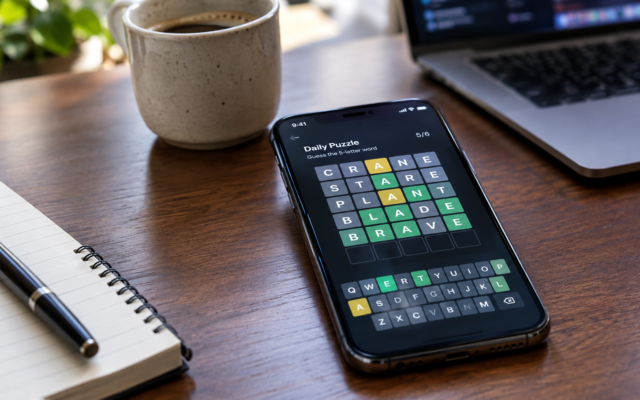

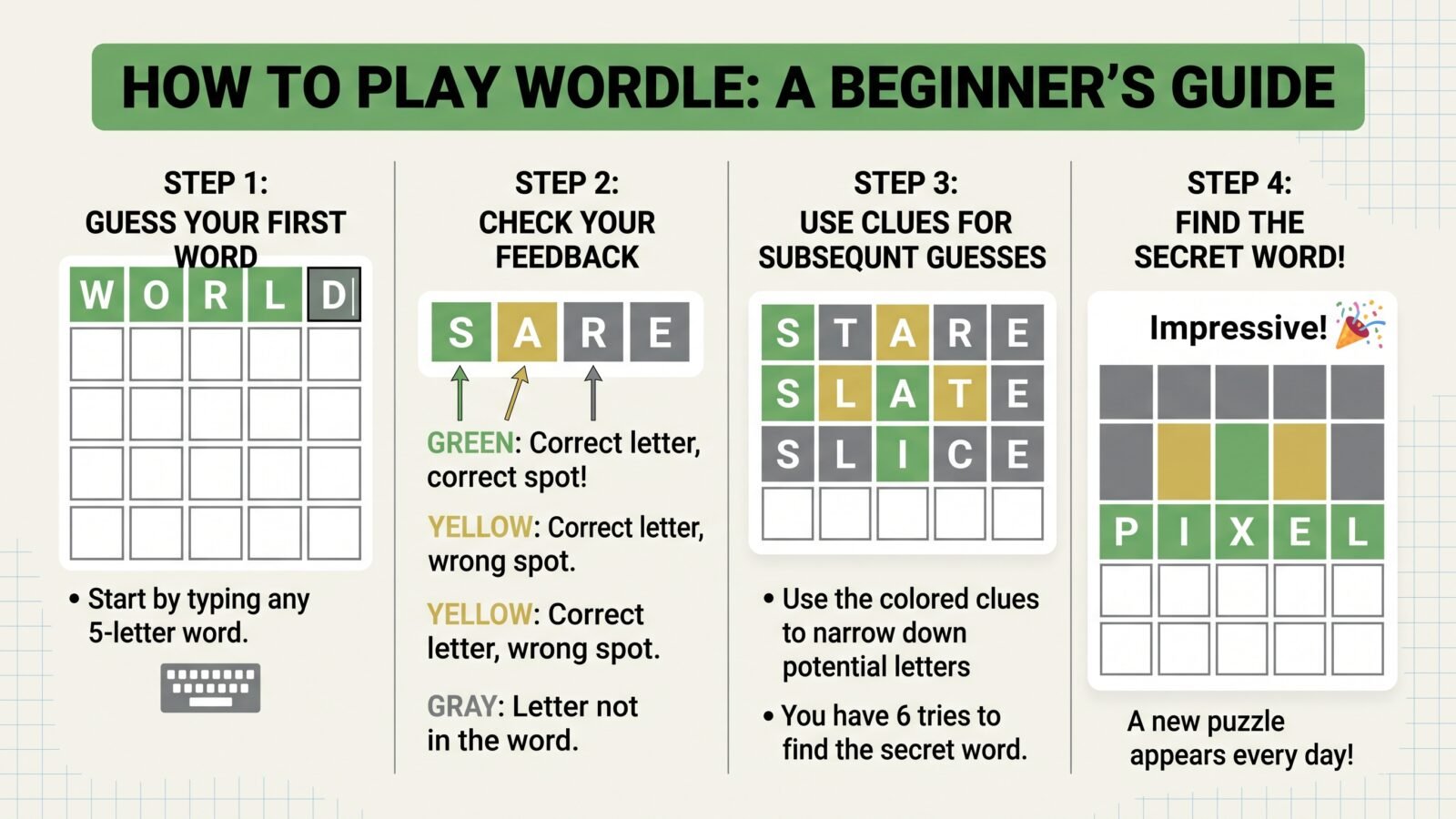
If you are new to Wordle, learning how to play Wordle is surprisingly simple. Wordle is a daily five-letter word game where you have six attempts to find the hidden word. After every guess, colored tiles tell you which letters are correct, misplaced, or not included in the answer.
The challenge is not just finding a word that works. You need to use each guess as a clue and narrow down the possible answers. With a few basic Wordle rules and smart guessing habits, beginners can quickly become better players.
What Is Wordle?
Wordle is a popular five-letter word game in which players try to guess one hidden five-letter word in six attempts.
The game gives you feedback after every Wordle guess:
- Green: The letter is correct and in the correct position.
- Yellow: The letter is in the answer but in the wrong position.
- Gray: The letter is not in the answer.
There is one main daily Wordle puzzle, so players around the world work on the same challenge each day. The simple rules, short games, and shareable results are some of the reasons the Wordle game became so popular.
If you want a basic introduction first, an article such as “What Is Wordle?” can provide additional background before you start playing.
also: Today’s Wordle Hints & Answer
How to Play Wordle
The basic process is easy to understand. Here is how to play Wordle step by step:
- Open the Wordle game.
- Enter a five-letter word as your first guess.
- Submit your guess to see the colored tiles.
- Study the green, yellow, and gray letters.
- Use those clues to make your next guess.
- Continue until you find the answer or use all six attempts.
For example, imagine your guess contains the letter A and the tile turns green. That means A is in the correct position and should stay there in future guesses.
If another letter turns yellow, you know it belongs somewhere in the answer but cannot remain in the position you just tried.
The key to how to play Wordle for beginners is to treat every guess as information. Even an unsuccessful guess can help eliminate several possibilities.
How Wordle’s Green, Yellow, and Gray Tiles Work
Understanding the tile colors is the most important part of learning how to play Wordle.
Green Tiles
A green tile means:
The letter is correct and in the correct position.
For example, if you guess:
C A R E S
and the A becomes green, the second position of the answer contains A.
Keep that letter in the same position when making your next guess.
Yellow Tiles
A yellow tile means:
The letter is correct, but it is in the wrong position.
For example, if you enter the letter T in the second position and it becomes yellow, T appears somewhere in the answer, but not in that position.
Your next guess should move T to another possible position.
Gray Tiles
A gray tile generally means:
That letter is not in the answer.
Gray letters are valuable because they help reduce the number of possible answers.
If your first guess shows that B, D, and M are gray, avoid using those letters in later guesses unless the game’s duplicate-letter rules make the situation more complicated.
What About Repeated Letters?
Wordle answers can contain repeated letters. This can sometimes make the color clues less obvious.
For example, if a word contains two of the same letter but your guess uses that letter more times than the answer does, Wordle’s tile colors account for how many instances of the letter are actually present.
This is one reason careful interpretation of the colors matters when solving difficult puzzles.
How Many Guesses Do You Get in Wordle?
You get six guesses to solve the Wordle puzzle.
Each guess must be a valid five-letter word accepted by the game. After every attempt, the tile colors provide clues about the hidden answer.
If you solve the puzzle before using all six guesses, you win. If all six guesses are used without finding the answer, the game ends and the correct Wordle answer is revealed.
Because you have only six attempts, avoid wasting guesses that do not provide useful information.
How to Choose Your First Word in Wordle
Your opening guess can make a big difference, although there is no single first word that guarantees a win.
A strong starting word usually contains several common letters and useful vowels. This gives you a better chance of discovering letters that appear in the answer.
When choosing your first Wordle word, consider:
- Use common vowels such as A, E, and O.
- Include frequently used consonants such as R, S, T, L, and N.
- Avoid starting with unusual letter combinations unless you have a reason.
- Try to test several different letters.
- Do not worry about finding the answer immediately.
For example, a starting word that tests several common letters can provide more useful information than a word containing repeated letters.
Some experienced players prefer starting with words designed to test vowels, while others prefer words containing common consonants. Both approaches can work.
The best starting strategy is the one that helps you gather useful information while keeping your later guesses flexible.
Powerful Tips for How to Play Wordle Better
Once you understand the basic Wordle rules, a few simple strategies can improve your results.
1. Use Your First Guess to Gather Information
Your first guess does not always need to be the word you think is the answer.
Think of it as an information-gathering move. Try to test several common letters and vowels so you can eliminate possibilities quickly.
2. Pay Attention to Yellow Letters
One of the most common beginner mistakes is finding a yellow letter and then forgetting about it.
A yellow letter is confirmed to be in the answer. Your job is to find its correct position.
3. Lock In Green Letters
Once you have a green letter, keep it in that position unless you have a specific reason to reconsider the situation.
Green letters give you some of the strongest clues in the game.
4. Avoid Reusing Gray Letters
If a letter has been confirmed as absent, there is usually little value in using it again.
Instead, use your next Wordle guess to test new letters or solve the positions of letters you already know.
5. Think About Letter Patterns
English words often follow recognizable patterns.
Common combinations such as TH, CH, SH, ST, TR, and ER can sometimes help you identify possible answers once you have enough clues.
However, do not force a pattern simply because it looks familiar. Always prioritize the information provided by the game.
6. Do Not Rush Your Final Guess
If you have several possibilities remaining, take a moment to compare them.
Ask yourself:
- Which letters are confirmed?
- Which positions are fixed?
- Which letters are possible?
- Which letters have been eliminated?
- Is there a guess that can test several remaining possibilities?
This simple process can prevent an avoidable mistake.
Common Wordle Mistakes to Avoid
Learning how to play Wordle is easy, but using the clues effectively takes practice.
Here are some mistakes beginners should avoid:
Repeating Eliminated Letters
If Wordle shows that a letter is gray, do not keep using it without a specific reason.
Ignoring Yellow Letters
A yellow letter is useful information. Do not treat it like a wrong letter. Move it to a different position.
Using Weak Guesses
A guess that tests letters you already know may waste one of your six attempts.
Forgetting Letter Positions
Green tiles tell you exactly where a letter belongs. Use that information to build your next guesses.
Guessing Randomly
Random guesses can quickly use up your six attempts. Every guess should have a purpose.
How to Win Wordle More Often
There is no strategy that guarantees you will solve every daily Wordle. However, you can improve your chances by making each guess more informative.
A practical Wordle strategy looks like this:
Start broad → identify letters → lock green positions → reposition yellow letters → eliminate gray letters → narrow the possibilities.
For example, your first guess may reveal two useful letters. Your second guess can test those letters in different positions while introducing additional common letters.
By the third or fourth guess, you should ideally have a much smaller group of possible words.
When only a few possibilities remain, think carefully before committing to the Wordle answer. If possible, choose a guess that helps distinguish between multiple remaining words.
The goal is not to guess faster. The goal is to make better guesses.
How to Play Wordle: A Quick Example
Imagine your first guess produces these results:
- Green: A
- Yellow: R
- Gray: S, T, E
You now know:
- A is in the exact position where you guessed it.
- R appears somewhere in the answer but is in the wrong position.
- S, T, and E are not useful letters for the answer.
Your next guess should keep A in its green position, move R somewhere else, and avoid the eliminated letters.
This is the basic logic behind the game. Every guess should make your understanding of the answer clearer.
Frequently Asked Questions About How to Play Wordle
How do you play Wordle?
To play Wordle, enter a five-letter word and submit your guess. You have six attempts to find the hidden word. Green tiles show correct letters in the correct positions, yellow tiles show correct letters in the wrong positions, and gray tiles show letters that are not in the answer.
What are the rules of Wordle?
The main Wordle rules are simple: guess the hidden five-letter word within six attempts, and use the colored tile feedback after each guess. Green means the letter and position are correct, yellow means the letter is correct but misplaced, and gray means the letter is not in the answer.
How many guesses do you get in Wordle?
You get six guesses for the daily Wordle puzzle. Each attempt must be a valid five-letter word accepted by the game. You need to use the feedback from each guess to identify the answer before your six attempts are exhausted.
What do the green, yellow, and gray squares mean?
Green means the letter is correct and in the correct position. Yellow means the letter appears in the answer but is in the wrong position. Gray means the letter is not included in the answer, subject to Wordle’s handling of repeated letters.
What is the best first word in Wordle?
There is no officially designated best first word that guarantees a win. Many players prefer opening words containing common vowels and consonants because they can reveal useful information early. The best approach is to choose a word that tests several common letters without relying on a guaranteed formula.
Can you play Wordle more than once a day?
The standard Wordle experience provides one main puzzle each day. Some players may use unofficial archives or alternative versions to play additional puzzles, but these are separate from the normal daily Wordle experience.
Is Wordle free to play?
The standard Wordle game has been available as a free daily word puzzle. Access details can depend on the platform and current New York Times policies, so players should check the official Wordle page for the latest information.
More Wordle Guides From InfoVerseDaily
If you enjoy the daily puzzle, you can build a useful Wordle resource section on InfoVerseDaily.com with related guides such as:
- What Is Wordle? — Learn about the game’s history, concept, and basic rules.
- Wordle Tips and Tricks — Explore additional strategies for solving difficult puzzles.
- Today’s Wordle Hints & Answer — Help readers who need clues for the current puzzle.
- Other Puzzle Game Guides — Discover instructions, tips, and strategies for other popular word and puzzle games.
Use descriptive internal-link anchor text such as “Wordle tips and tricks” or “today’s Wordle hints and answer” rather than generic phrases like “read more.”
Final Thoughts on How to Play Wordle
Learning how to play Wordle takes only a few minutes, but becoming a better player comes from using the clues carefully.
Remember the basic process: enter a five-letter word, study the green, yellow, and gray tiles, and use that information to improve your next guess. You have six attempts, so make every Wordle guess count.
For beginners, the most important Wordle tips are simple: start with useful letters, pay attention to yellow clues, protect your green letters, avoid eliminated letters, and think about the remaining possibilities before making your final guess.
With practice, you will become better at recognizing letter patterns and narrowing down the Wordle answer without relying on random guesses.